SEER · First public proof
CORV
Issue-to-decision intelligence for construction operations.
CORV connects your documented project data, detects risk patterns, traces every finding to source, and prioritizes action across three screens. It’s the first concrete evidence that SEER’s method works.
SHT 01What it actually is
Primarily algorithmic — not just AI.
CORV is an intelligence layer over the tools you already run. The model only accesses post-processed retrieval over your documented data — and every insight carries a confidence level.
Documented sources only
RFIs, schedules, daily reports, pay apps, change-order logs. No text messages, no informal calls.
Traced to source
Every finding maps back to the specific records that produced it — auditable, not opinion.
Confidence on everything
Each insight is presented with a confidence level, so you know how much weight it carries.
No behavioral overhaul
Little-to-no integration period. It reads what's there and involves the pipeline organically.
SHT 02Issue to decision
Three screens. One decision rhythm.
Risk, then Disposition, then Scenario — a real sequence, because the order carries information the reader needs.
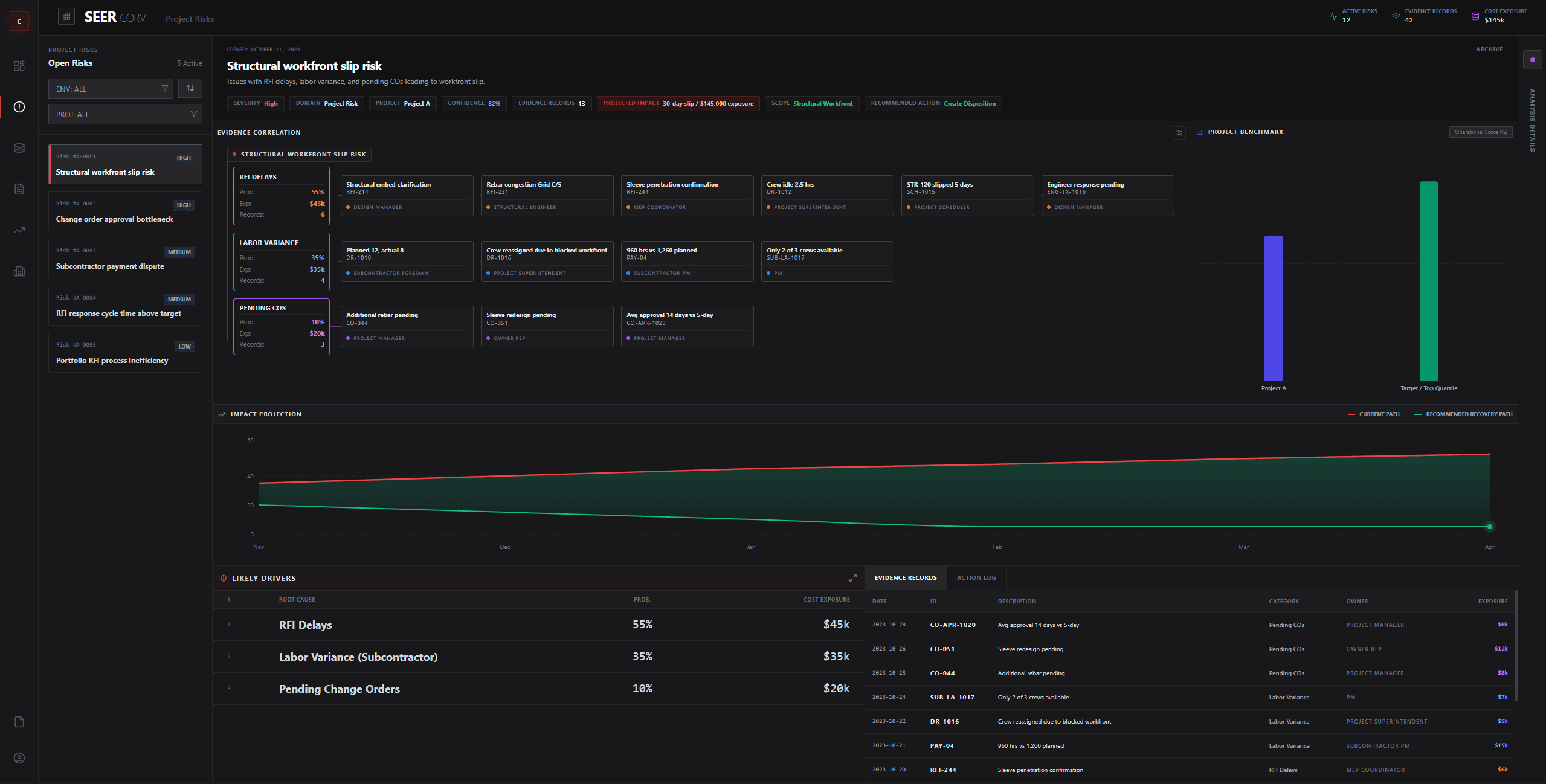
Risk
Every active project, ranked by severity and scored by confidence. Each issue opens onto the evidence behind it — correlated records grouped by driver, with projected impact and exposure already computed.
- Severity and confidence on every issue
- Evidence correlation grouped by driver
- Projected slip and dollar exposure
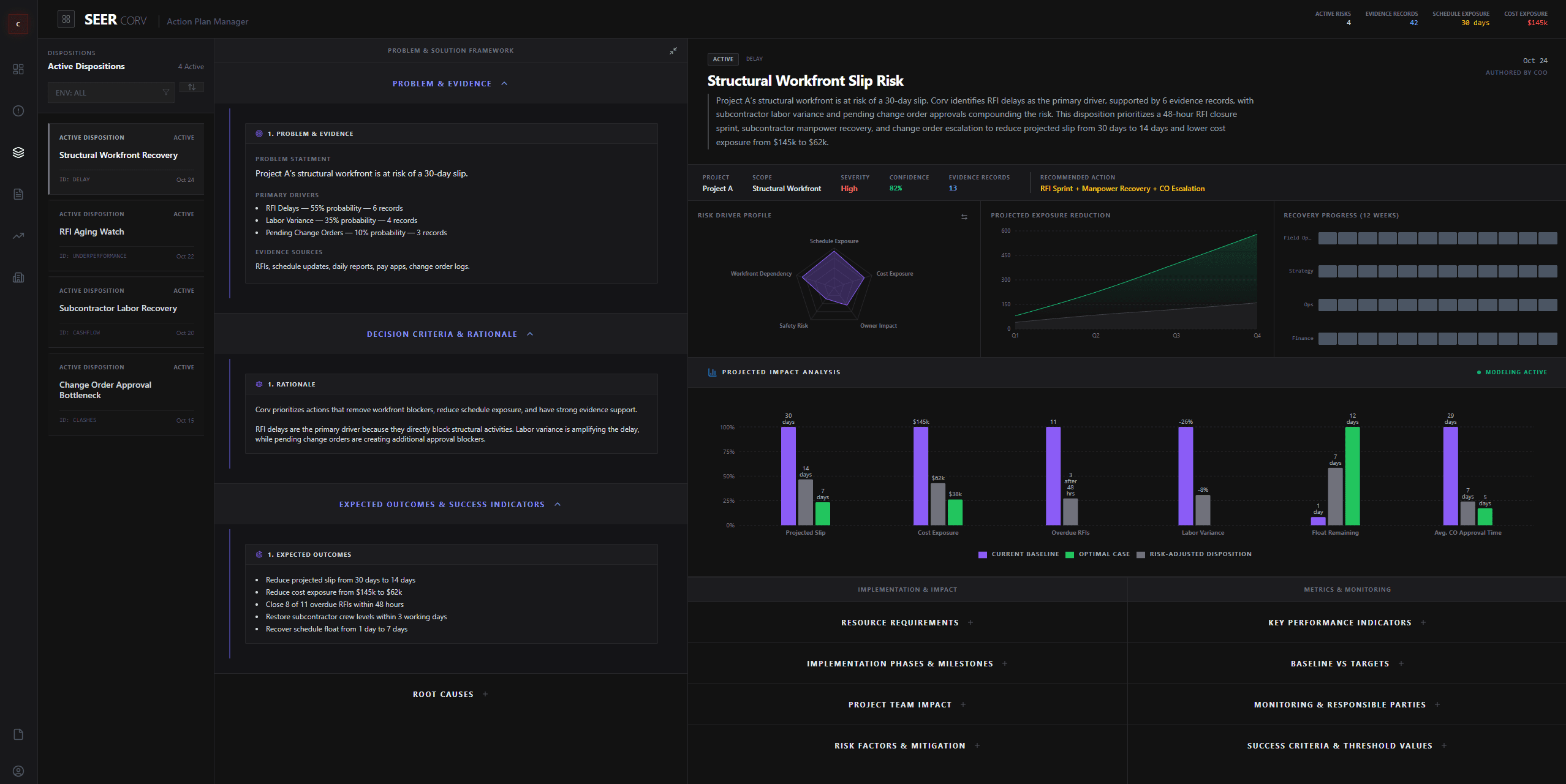
Disposition
A specific action plan mapped to root causes — problem, evidence, rationale, and expected outcome. Owners, deadlines, and the effect each action is expected to have, so the decision is defensible on record.
- Root causes with probability and cost
- Action plan with owners and deadlines
- Expected outcomes and success indicators
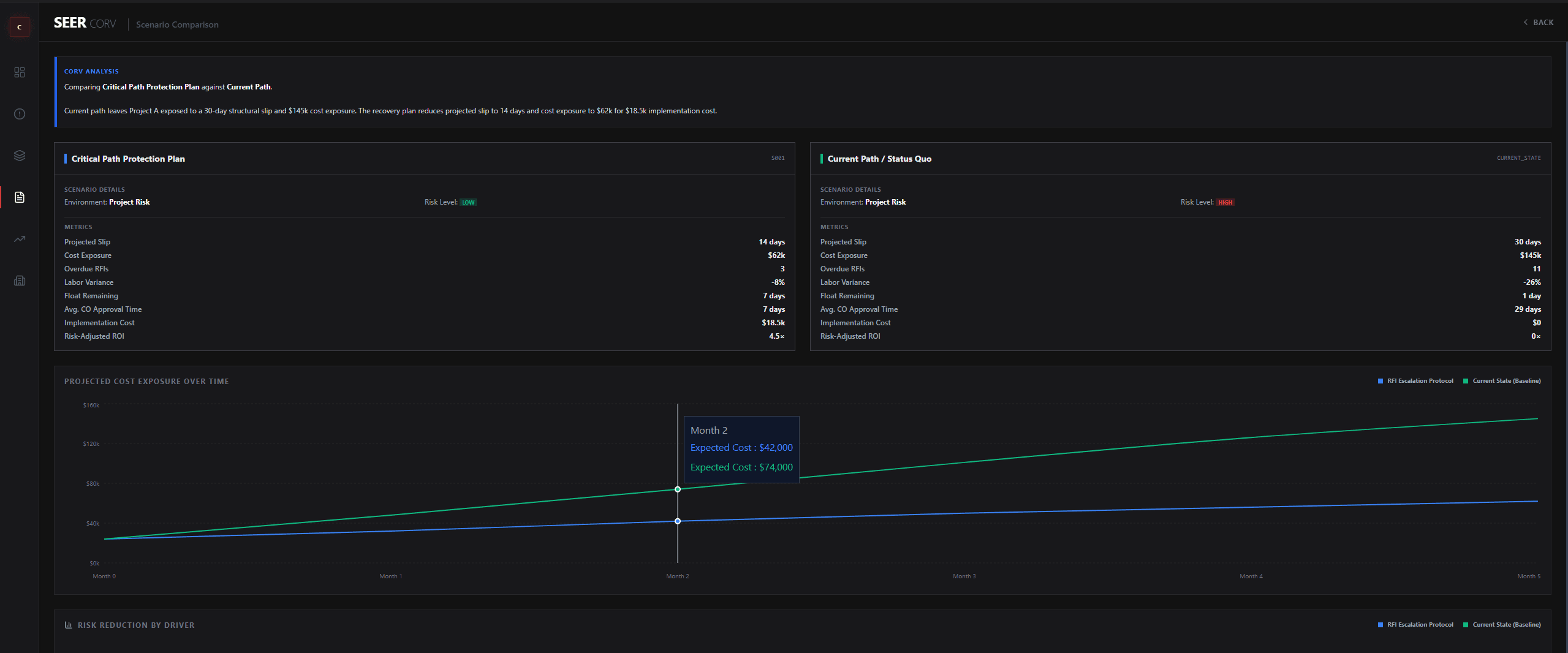
Scenario
Current trajectory against a recovery path and no action — projected slip, cost exposure, and risk-adjusted ROI over time. Quantified exposure avoided before a single dollar is committed.
- Recovery path vs status quo, side by side
- Projected cost exposure over time
- Exposure avoided, quantified up front
SHT 03A layer, not a replacement
It connects what you already document.
No rip-and-replace. CORV reads the record across your existing systems and assembles one defensible picture of the truth.
SHT 04What you get
Outcomes, before any price is mentioned.
Ranked, severity-scored issues
A prioritized list of what's actually putting margin, schedule, or safety at risk — pulled from RFI logs, daily reports, and pay apps across every active project, not a noisy feed of everything that moved.
Root-cause clarity
Every issue traced to its real driver — RFI age, manpower variance, a stalled change order, a coordination clash — not the downstream symptom a super reported at standup.
Dependency mapping
See which trades, activities, and milestones sit downstream of a single blocked workfront before the delay cascades through the schedule.
Evidence-backed disposition
A specific recovery plan mapped to root cause — owner, deadline, expected effect — not a to-do list you have to defend in the next OAC meeting.
Scenario comparison
Current trajectory against a recovery path and doing nothing — cost exposure and schedule slip quantified for each, before a dollar or a crew hour is committed.
A weekly decision rhythm
Operators stop rebuilding the story from seven people and twelve systems every Monday. They open CORV, and the story — what changed, what it's worth, what to do next — is already built.
SHT 05What changes
The story is already built when you open it.
For the operator
Fewer 6:45 AM firefights. The risk is surfaced days earlier, evidence already connected. You answer leadership's hardest question — what's happening, why, and what do we do today — in minutes, not hours.
For the executive
Cross-project visibility without chasing status meetings. You're the lighthouse, not the messenger. Decisions are defensible because they're built on traced records, not opinion.
For the business
Margin protected, schedule slip caught early, subcontractor accountability documented, cash-flow risk made visible before it bites. The cost of not knowing drops to near zero.
Proven in principle
Proven in principle. Deploying in practice.
CORV has been tested extensively on illustrative datasets modeled on real construction operations. Repeated testing showed consistent improvement in risk detection and decision clarity from documented, shared data alone — proving the methodology works before a single live deployment. The dashboards shown here are demonstration environments, not client records.
SHT 06Engagement
Start narrow. Prove it. Then scale.
The diagnostic is the entry point — read-only, time-boxed, and designed to ask nothing of your systems.
Focused Diagnostic
START HERE$10,000
10–15 business days
A read-only, time-boxed review of one or two active projects.
- Ranked issue list with root-cause analysis
- Exposure estimates and recommended action plans
- Scenario comparison
- Executive findings presentation
- Executive risk summary — the single highest-risk issue, its root cause, and its exposure, stated plainly
- Ranked issue list across both projects, by severity and estimated exposure
- Root-cause breakdown on the top 3–5 issues — what happened, why, and which records prove it
- A dependency map showing what a single blocked issue puts at risk downstream
- Disposition recommendations — owner, deadline, and expected result, for each major issue
- Scenario snapshot — current trajectory vs recommended action vs optimized case
- An ROI estimate — identified value exposure set against the diagnostic's own cost
- A 60–90 minute findings walkthrough with your team
90-Day Pilot
$75,000
2–4 active projects
A weekly decision workflow across live projects.
- Standing Risk → Disposition → Scenario rhythm
- Final value report — found, recommended, protected
- Where value was created or protected, on record
- Severity ranking, root-cause analysis, and disposition pages — the diagnostic's rhythm, standing across 2–4 projects
- A weekly risk report, delivered on a rhythm your team can plan around
- A weekly review call to walk through what changed and what to do next
- Manual or semi-automated import from your existing systems — no rip-and-replace
- A final ROI and value report — what was found, recommended, and protected
Annual Conversion
Dependent on portfolio scale
Full portfolio
CORV engrained as a standing operations intelligence layer.
- Portfolio-wide coverage
- Continuous risk and disposition monitoring
- The operating picture, always current
A narrow first step
The firms that move first in this shift won’t be the largest — they’ll be the ones who chose to see earlier. A $10,000 diagnostic is a narrow, read-only, time-boxed first step. It asks nothing of your systems and commits nothing beyond a single question: what is quietly slipping on your projects right now, and what is it worth to know before your next leadership meeting?
This is the first public proof of what SEER is building toward — and the construction leaders who engage now aren’t buying software. They’re positioning themselves at the front of a change that is already underway.
A meeting to determine which one or two projects should begin.